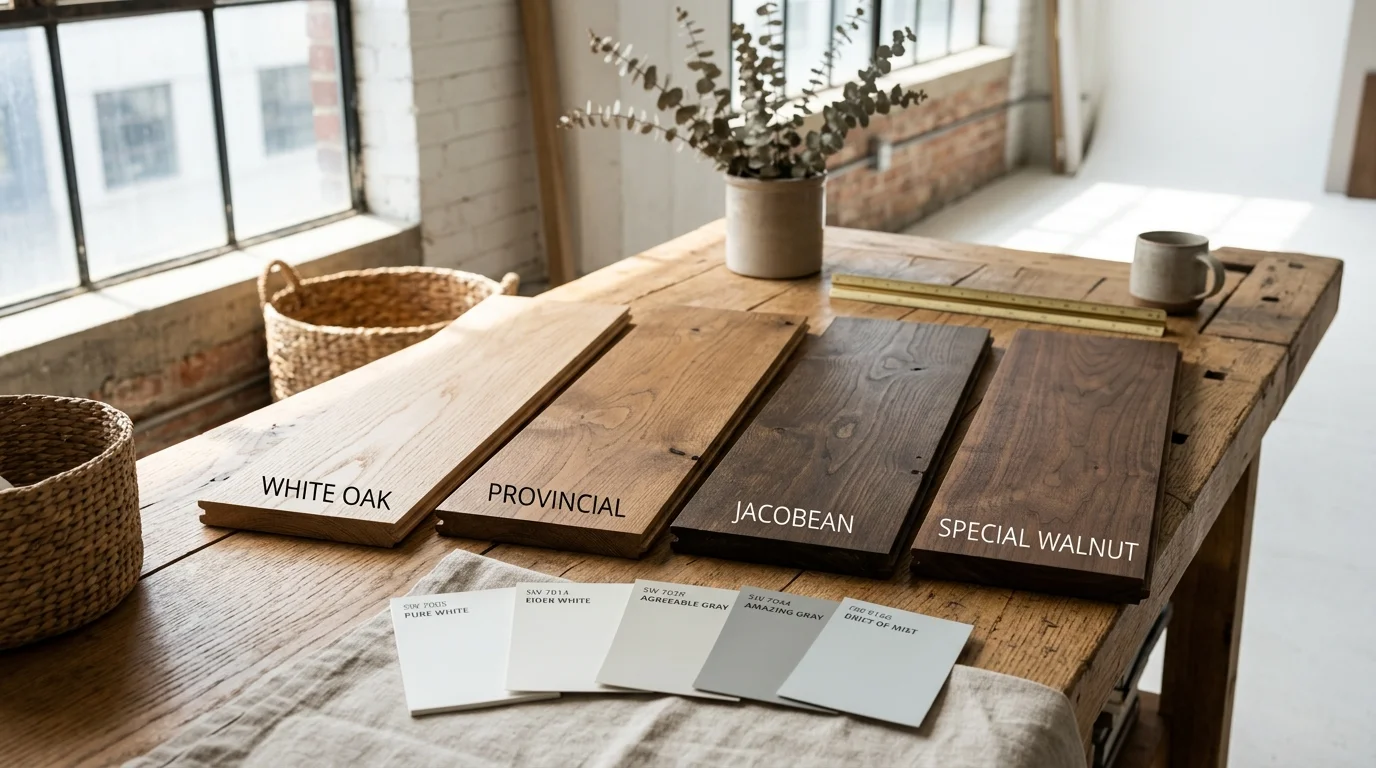
Spectrophotometric Floor-to-Wall Pairing Principles
Hardwood floor stains introduce strong organic tannins, yellow ambers, and brown pigments into the room's lower reflectance field. Successful color harmony requires aligning the wall paint's dominant undertone with the stain's primary wood grain temperature.
When choosing wall colors, interior designers benchmark the floor's effective Light Reflectance Value against wall luminance. Dark stains like Jacobean (LRV ~10) absorb incident daylight, requiring high-LRV walls (LRV 75-85) like Alabaster or Pure White to preserve room illumination. Explore our complete color spectrum in the master paint colors workbench.
White Oak & Natural Raw Wood: Harmonizing with Warm Off-Whites
Natural and white-washed White Oak features neutral-to-cool tan grain with minimal red or golden flare. This makes it exceptionally versatile across Scandinavian and organic modern palettes.
Alabaster SW 7008 (LRV 82)
Infuses creamy architectural warmth without clashing with the subtle wheat tones of white oak.
Shoji White SW 7042 (LRV 74)
Gentle greige bridge with beige undertones that seamlessly mirrors raw wood finishes.
Pure White SW 7005 (LRV 84)
Clean, near-achromatic trim perimeter that accentuates natural timber grain lines.
Provincial & Special Walnut: Calibrating Warm Amber and Greige Tones
Minwax Provincial and DuraSeal Special Walnut balance rich medium-brown pigments with gentle yellow-gold warmth (LRV 18-24). Pair Provincial floors with cool-neutral or green-cast greiges such as Repose Gray SW 7015 or Agreeable Gray SW 7029 to neutralize excessive amber glare during south-facing afternoon exposure.
Jacobean & Dark Walnut: Dramatic Grounding with High-Contrast Neutrals
Jacobean delivers deep espresso tones with charcoal-cool undertones, while Dark Walnut leans slightly richer with deep cocoa notes. Because both absorb significant ambient light, wall formulations must supply daylight bounce. Pairing Jacobean flooring with Accessible Beige SW 7036 (LRV 58) produces a grounded luxury atmosphere.
Contrast Wall: Accessible Beige
SW 7036 balances deep espresso floor tones with warm earthy richness.
Contrast Wall: High Reflective White
SW 7757 reflects maximum daylight to counteract dark timber light absorption.
Trim & Doors: Iron Ore
Iron Ore SW 7069 ties deep floor grain into door frames and moldings.
Frequently Asked Questions: Hardwood Floor Stain & Wall Paint Coordination
01 What paint color goes best with natural White Oak floors?
Natural and rift-sawn White Oak floors have low yellow chroma and subtle wheat-tan grain. They pair exquisitely with warm off-whites like Alabaster SW 7008, crisp neutrals like Pure White SW 7005, and soft organic greiges like Accessible Beige SW 7036 without clashing.
02 How do I counteract orange or red undertones in Provincial stain?
Provincial stain has a classic warm amber-brown base. To balance its warmth, select wall colors with neutral or gentle green undertones such as Repose Gray SW 7015, Agreeable Gray SW 7029, or Sea Salt SW 6204. Avoid pink-beige paints which will accentuate orange tones.
03 Which wall colors work with dark Jacobean and Dark Walnut floors?
Jacobean and Dark Walnut provide strong grounding contrast (LRV ~8-12). High-reflectance whites and mid-tone greiges like Shoji White SW 7042, Alabaster SW 7008, and Accessible Beige SW 7036 create an architectural contrast ratio greater than 7:1, elevating room brightness.
04 Should wall paint be lighter or darker than the hardwood floor?
In 90% of residential interiors, walls should possess a higher Light Reflectance Value (LRV > 60) than the floor (hardwood LRV typically 10-35). This creates vertical expansiveness and prevents a cave-like aesthetic, allowing the wood grain to anchor the space.
05 Does floor sheen affect wall paint reflection?
Yes. High-gloss polyurethane reflects directional daylight upward toward the lower 36 inches of drywall, intensifying perceived wall color chroma. Matte or satin hardwood finishes absorb specular light, keeping paint colors truer to their laboratory drawdowns.