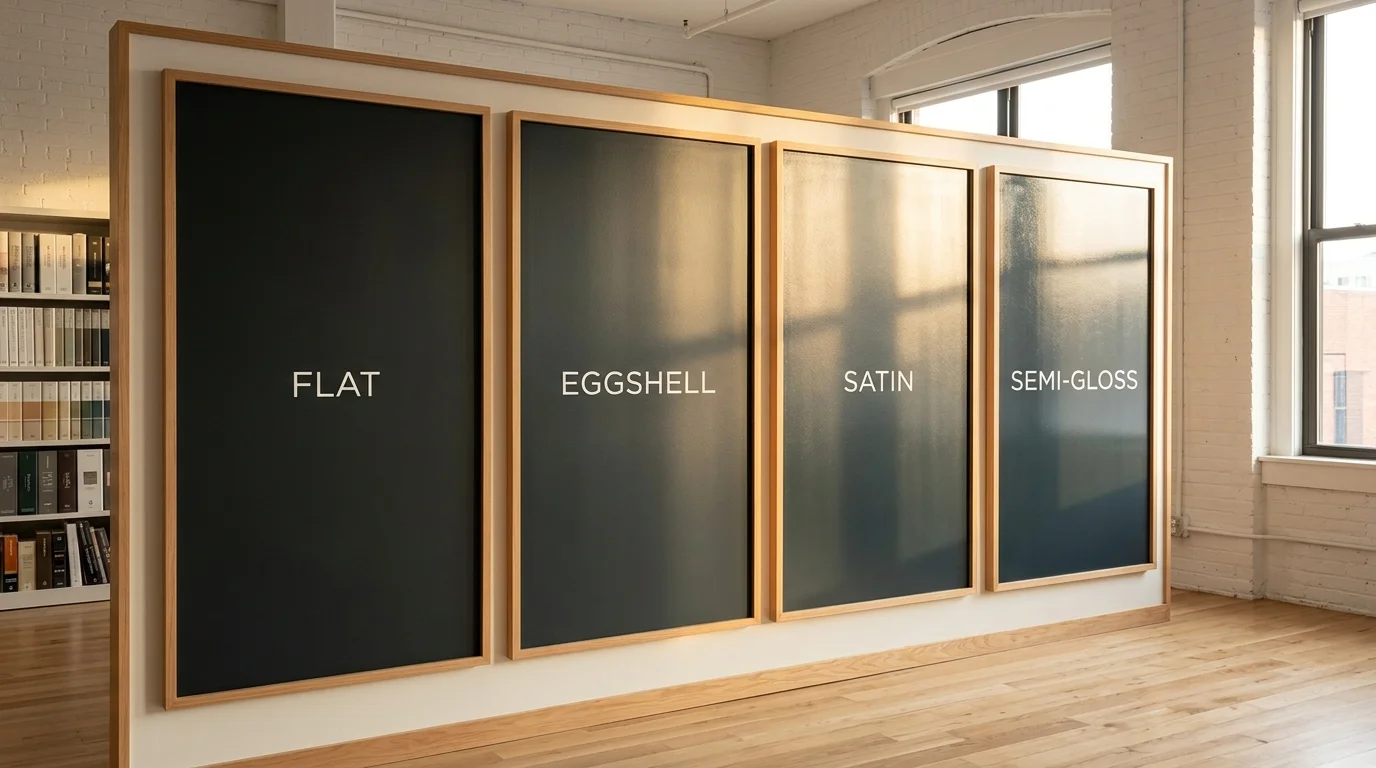
How Paint Sheen Multiplies Perceived Light Reflectance Value
Light Reflectance Value (LRV) measures the percentage of total light reflected from a cured paint film under diffuse laboratory illumination. However, sheen introduces specular reflectance: direct mirror-like light bounce that amplifies perceived brightness and alters color saturation.
A paint formulated at an LRV of 60 (such as Accessible Beige SW 7036) will visually read as an LRV of 58 in a dead-flat finish, but may reflect highlights equivalent to an LRV of 64 when specified in a semi-gloss enamel under direct downlighting. Explore our full library of reflectance ratings in the master paint colors workbench.
Flat & Matte Finishes: Maximum Undertone Fidelity and Ceiling Dispersion
Flat finishes contain high pigment-to-binder volume ratios (PVC > 60%). The microscopic surface roughness scatters incoming photons omnidirectionally, delivering velvety depth and masking wall irregularities.
Flat Ceiling Paint
Eliminates surface glare and visual seams across vast drywall ceilings under low-angle sunlight.
Matte Wall Finish
Preserves pure undertone pigments without plastic reflections, ideal for primary master suites.
Drywall Camouflage
Absorbs grazing light to obscure patches, taped joints, and imperfect drywall framing.
Eggshell & Satin Finishes: The Residential Sweet Spot for Living Spaces
Eggshell (10-25% gloss) balances low-angle diffuse reflection with cleanability, making it the premier choice for family rooms, hallways, and dining spaces. Satin (25-35% gloss) introduces subtle luster that withstands scrub cycles in busy kitchens, laundry rooms, and children's bedrooms.
When using warm whites like Alabaster SW 7008, eggshell prevents subtle beige pigments from washing out under south-facing solar exposure while allowing effortless wipe-down maintenance.
Semi-Gloss & High-Gloss Finishes: Specular Highlights and Architectural Trim
Semi-gloss enamels provide durable resin shields for baseboards, moldings, and doors. The high specular reflectance creates a clean shadowline contrast against eggshell walls, even when using monochromatic color schemes.
Semi-Gloss (35-70% Gloss)
Maximum washability and moisture resistance for moldings, millwork, and high-touch doors.
Satin / Semi-Gloss Hybrid
Durable urethane enamel that repels oils while highlighting subtle bevel lines.
Sheen Step-Off (0.8 Delta)
Pair Alabaster eggshell walls with Alabaster semi-gloss trim for automatic tonal separation.
Frequently Asked Questions: Paint Sheen Selection and LRV Interactions
01 Does higher sheen make a paint color look lighter or darker?
Higher sheen increases specular reflection (directional glare), which can make a color appear 1 to 2 shades lighter where light hits it directly, but deeper and more saturated in shadowed areas. Flat paint scatters light uniformly, making the color appear softer and truer to the swatch.
02 What is the best paint sheen for interior living room walls?
Eggshell is the undisputed industry standard for living rooms, bedrooms, and dining spaces. It offers a subtle, velvet-like low luster (10-25% gloss units at a 60-degree angle) that cleans easily without broadcasting drywall imperfections.
03 Why should ceiling paint always be flat?
Ceilings have vast, unbroken expanses of drywall subjected to grazing daylight from high windows. Any sheen higher than Flat (0-5% gloss) will highlight seams, screw pops, and texture unevenness. Flat paint absorbs glancing light, creating a calm, unified canopy.
04 What sheen should be used on doors and baseboard trim?
Semi-Gloss (35-70% gloss) or Satin is the architectural standard for trim, doors, and millwork. The elevated resin binder concentration creates a hard, non-porous shell that resists shoe scuffs, hand oils, and frequent washing.
05 How does bathroom moisture interact with paint sheens?
In high-humidity bathrooms without industrial ventilation, avoid flat or matte finishes. Moisture droplets penetrate porous low-sheen films, leading to surfactant leaching and mildew. Satin or semi-gloss moisture-resistant formulations (like Sherwin-Williams Duration Home) provide the necessary protective vapor barrier.